Posts Tagged ‘software’

DockView Shows App Thumbnails

Monday, August 30th, 2010

Jealous of Windows 7′s ‘thumbnails’ that show up when the mouse hovers over an app on the task bar? DockView offers the same functionality, and more, for Mac OS X.  This great little app is only $7.99 and is free to try out with no limitations except an annoying and occasional ‘buy me’ window. The app plays nice with OSX’s Spaces so long as you switch to each Space and activate the app in that Space at least once.  So, if you have Preview PDFs open across three different Spaces, you can switch to them via the Dock thumbnail.  Additionally, when using Command-Tab, DockView also provides the pop-up thumbnail allowing quick switching for apps and windows. Finally, and better than Windows 7′s thumbnails, you can:

(1) alter the height and width of the pop ups; and, (2) pause, play and skip in the iTunes thumbnail. Genius and well worth the $7.99.

Distractions and Correcting Focus

Sunday, June 13th, 2010

The internet, according to some, is destroying our ability to maintain focus.  Of course, our ability to maintain focus plays a key role in our work as lawyers. Reading a ten page memorandum dense with argument, analysis, complex factual patterns and case citation requires a good deal of focus. But, it may also require accessing the internet. Hence, the dilemma. So, here is a solution. Pomodoro Technique + Concentrate Software = Focusing.

The Problem

The New York Times is running a series “Your Brain On Computers.” The problem, for lawyers who need to focus, comes down to this:

Scientists say juggling e-mail, phone calls and other incoming information can change how people think and behave. They say our ability to focus is being undermined by bursts of information.These play to a primitive impulse to respond to immediate opportunities and threats. The stimulation provokes excitement — a dopamine squirt — that researchers say can be addictive. In its absence, people feel bored.

In sum, and contrary to most critics, lawyers are mammals and ‘ooh, look, shiny’ still applies. The Times article is a great read and a highly recommended to anyone who thinks they don’t have this focus problem.

Pomodoro

Pomodoro Technique ™creates a limited time where you focus on a single task. Knowing that this will be the time during which you focus, you key yourself to that task. For 25 minutes, you focus on nothing but the task at hand. At the end of 25 minutes, you take a five minute break. During that five minute break, get up, stretch, get a cup of coffee, check your email return a phone call. But get back to it after 5 minutes for another Pomodoro.  Lather, rinse, repeat and create a hash mark on a piece of paper for each Pomodoro you complete.

Pomodoro, for you billable types, tailors nicely with the 2/10 (or even 1/10?) billable. Complete a Pomodoro, and you’ve finished up 4/10 of a billable hour. For you contingency types, Pomodoro can stop you from running wild with research and work on a case… there truly is no end to the amount of time you can spend on a single case.

Concentrate

Now, bring a little muscle to bear. Pomodoro technique relies on a kitchen timer with a ‘ding’ to let you know when to break. Concentrate, is a handy piece of customizable software that blocks whatever you want to keep you from being bothered. It will shut off your IM, your email client and, if you tell it do so, will block designated web sites or even all access to the internet. And, it will do this for a set period of time so that you can’t sneek back, just to check and see how much more oil has spilled on that live video feed.

Maclitigator recommends three different Pomodoro ‘types’ in Concentrate. All three shut down mail apps, set chat status to ‘away’ and play a ding at the end of 25minutes. First up, PomoGoogleOK. This Concentrate pattern blocks most distraction domains (you can add whatever you want) such as flickr, groups.google.com, metafilter, facebook, twitter, video sites and mail.google.com. This Pomo allows you to search and research as needed on the broad internet without getting sucked into any of the typical distractions.

PomoNoWeb does exactly what it says… no internet access at all.

Finally, PomoWestlawOnly does just that as well. All internet access except Westlaw gets blocked. Concentrate is $29 and well worth it.

One Last Step

Find the DND (“Do Not Disturb”) button on your desk phone. Push it when you start the Pomo. Find the sleep button on your cel phone. Push that button too. Find the door to your office. Close that. If necessary, tell your staff what you are doing and that you will be available later at a set time.

The Payoff

Two things occur when using this technique. First, at the ‘ding,’ you will probably find yourself startled or feel a bit interrupted, as if you were just getting into the zone. That’s o.k. Take the break. You’ll be eager to pick up where you left off and you might even gain some additional insight while walking around.

Second, if you do this regularly, you’ll begin to notice a flow. Working Pomodoro for a few days ends up creating the habit of working in 25 minute bursts and a certain ebb and flow will develop that carries over even when not formally running the clock.

iPad & OSX Apps for Appeals

Wednesday, May 5th, 2010

Working with the iPad at oral argument before an appellate court, trial court or other hearing cuts down on killing trees while keeping all information at your fingers. Rather than print out reams of pleadings and argument outlines, the iPad can display all the information you need, but it takes a bit of work to ditch the three ring binder.  Here are the apps, both iPad and Mac OS X, that will get you there.

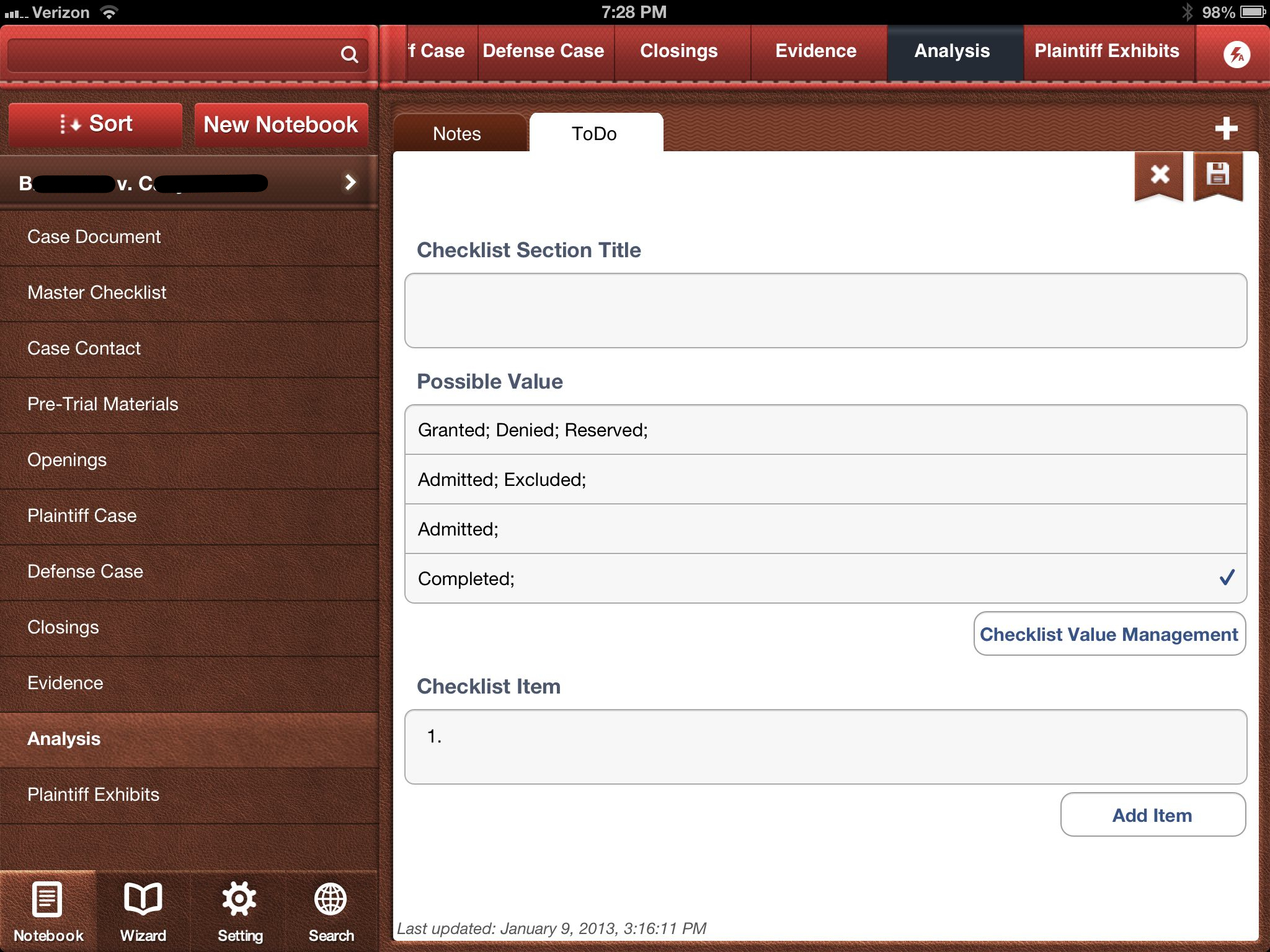
OmniOutliner/Circus Ponies Notebook

Drafting argument outlines in a dedicated outliner works far better than the 1998 method of turning on outlining mode in Word. Both OmniOutliner and Circus Ponies Notebook (CPN) provide not only excellent outlining tools, but the ability to ‘attach’ your pleadings, exhibits, deposition transcripts etc. directly within the outline as a PDF file. For purposes of getting an outline onto the iPad, CPN provides the better approach until OmniGroup releases OmniFocus for iPad sometime this summer.

Circus Ponies is much deeper than a simple outliner.  Hyperlinks can jump across the entire notebook to cross reference other related items on different pages. Additionally, CPN provides a robust indexing of the entire notebook and advanced sorting and flagging features. Finally, and crucial to getting all this info onto your iPad. CPN offers two key export methods. First, the entire notebook can be exported to PDF with both page numbers and chapter-page numbers.  Second, the entire notebook, PDF attachments included can be exported as a website. That means that CPN will export your notebook as a fully hyperlinked document with PDF images, functioning expand/collapse arrows on the outline and any tabs added to the side as a self sufficient website.  From CPN choose File>Export as a Website>To Disk.  It’s easiest to do this if you create a ‘temp’ folder on your desktop and save the file there.  CPN kicks out an index.html file and a few folders.  Double click the index.html folder and you’ll open the notebook in Safari/Firefox.  Getting that notebook-as-website on your iPad and functioning is the next step.

Air Sharing HD

Air Sharing HD is the most direct method and highly recommended independent of this exercise.  Air Sharing HD creates a network connected hard drive accessible from your Mac.  Following theinstructions for the software gets you a mounted hard drive on the iPad where you can then drag and drop documents and folders through Finder.  Take the ‘temp’ folder from your desktop containing your Notebook as website and drag it to the iPad mounted hard drive. Next, from within Air Sharing HD, open that temp folder and tap on ‘index.html’ and your complete notebook opens. Tapping on any of the links, tabs or pages works just like a click.  Additionally, you get any PDFs saved inside the outline and, tapping on those PDFs opens them in full screen mode. Hit the ‘back’ button and your back to your outline.

A Second Method: iAnnotate PDF Approach

Another approach uses strictly PDFs. After composing an outline, print the file as a PDF. Then using iAnnotate, ‘import’ those documents. iAnnotate has a ‘server’ application that resides on your Mac. Designate a folder, and iAnnotate will upload all PDFs contained in that folder. This allows you to load not only your argument outline, but also related pleadings and documents. Most importantly, iAnnotate provides a tabbed interface, allowing you to switch back and forth between documents quickly. It is especially helpful that iAnnotate allows searching within a PDF if the document has been OCR’d. In testing, iAnnotate handled a 422 page record on appeal, two 40 page appellate briefs, the argument outline and a few pages of Utah Code Annotated with no problems. By contrast, using Air Sharing HD with CPN, opening the 422 page record on appeal as a PDF was noticeably laggy and slow, although it handled shorter documents just fine. Tablet Legal recently covered iAnnotate’s features in detail.

Both approaches are a bit of a kludge in terms of loading the iPad. Still, it remains much easier and more environmentally friendly than the old three ring binder approach.

Dragon Dictation for the iPhone

Tuesday, December 8th, 2009

“Finally, dictation software you might actually find useful. Nuance the makers of dragon dictation, released an iPhone application today. Unlike Mac speech,iTunesthere’s no training required and the dictation software work works remarkably well. In fact, this entire blog entry was dictated using DragonDictate for the iPhone . Dragons the iPhone is free for the taking from the app store.”

The above was dictated using Dragon and is presented unaltered from the original. You’ll notice the error with the period at the second to last sentence and the last sentence itself should read “Dragon for the the iPhone is …”

The error from the period arises because the app can only handle a limited amount of dictation before it stops dictating, then you must start dictating again. Still, a pretty useful little app to have around. It lets you cut n past from app into SMS, email etc which can make it very handy for responding to emails and SMS without needing to type. For longer dictation projects, probably not all that useful.

Snow Leopard Compatibility Checker

Monday, November 2nd, 2009

A downloadable and free piece of software will help you determine whether or not Snow Leopard cripples your favorite piece of software or, more accurately, whether the developer of your favorite piece of software totally ignored the inevitable and has left you high n’ dry… I’m looking at you Fujitsu Scansnap (limited functionality under Snow Leopard) and Vonage Companion (completely borked).

Snowchecker via Lifehacker.

PersonalBrain Screencast

Friday, October 9th, 2009

PersonalBrain offers some really nice features which may be of interest to lawyers. Years ago I tried to use this software in lieu of Casemap, while still working in the Windows environment.  Originally called ‘The Brain’ it had a lot of flash, but was thin on substance.  Since that time, upgrades and improvements have come a long way…. tagging, attachments etc. Here’s a screencast showing PersonalBrain in action with some legal research originally collected and kept in the now defunct Journler. Apologies for the crappy YouTube resolution. FWIW, click on the ‘fullscreen’ & ‘HD’ buttons, bottom right, for best viewing.

Three things not mentioned in the screencast. First, the software is cross-platform and can be used on both Windows and Mac provided you have licenses for both. Second, because the software is cross-platform and because it has been around for quite some time, it is likely that it will continue to be around for some time. Finally, the software has a great export feature which allows you to export the entire ‘Brain’ as a self-sufficient webpage. I haven’t tried this out yet, but the possibilities of being able to share a brain with an expert and/or client are tantalizing.

Google Voice Widget

Friday, August 14th, 2009

Somebody (Apple? AT&T? a conspiracy?) may have killed the Google Voice iPhone Apps, but there is a new widget out that allows you to dial using Google Voice from your Dashboard, GV Connectgvc_call. A huge plus to dialing using your GV number is that people will use it to call you back when looking at their caller I.D.  However, dialing from that number is cumbersome, requiring you to log in to your google account, go to the GV web page, and then dial out. GV Connect does all this, right from your dashboard, lets you choose which of your registered phones the call will connect with and, perhaps most importantly, integrates with your OS X address book. Oh, and you can also SMS directly from the widget. While this doesn’t take the bitter out of your mouth at the loss of an iPhone app for GV, it’s at least a little sugar to make it more bearable.

Another widget added to the collection, replacing the previous time zone clock set up, is iSlayer’s Organized.  This hand widget gives you clocks, calendar, todo and a place to jot down your notes.

organized-sml

MacJournal and Replacing Journler

Wednesday, July 1st, 2009

MacJournal

When hunting around for a ‘Casemap’ replacement a few years back, MacJournal entered onto the final list. Now, because of its ability to import Journler data, complete with tags, MacJournal finds itself doing heavy lifting on case analysis.  Caveat, MacJournal will not pull over images or any metadata other than tags.

Initially, MacJournal lacked the ability to change the date of each entry, making it impossible to use for case analysis chronology.

Pros: Can save individual documents, making client-matter project management easier. You can save a journal as a ‘document’ into Dropbox for each client-matter.  Additionally, this offers the opportunity to keep one journal as your ‘attorney’s daybook’ where you drop all the tidbits that accumulate.  MacJournal has an excellent developer (Dan Schimpf answers questions and listens to user input – check his blog). Questions, comments and concerns often get a personal response.

Cons: PDF/attachment handling is done ‘inline,’ kind of ugly, but not a deal killer; No ‘filter’ option for doing a quick filter of entries based on Tag, Annotation, Date, or Content, i.e. must create a ‘smart folder’ to accomplish, still not a deal killer; proprietary file format and structure, but considering responsiveness and longevity of MacJournal/Mariner, still not a deal killer.

journler-importmjdoc

When conducting document review with MacJournal, it goes like this: (1) With a document open in Preview, hit Command-c when you come across a choice page; (2) switch to MacJournal and create a new entry, date it, add tags and, in the main body jott a few notes; (3) hit Command-v and the page is dropped into MacJournal for later reference/review. Double clicking the image opens it in Preview where you can annotate/mark-up/add notes if you desire. This approach is simple, quick and gets the job done with a minimal of effort. And, yes, it can be used to review deposition transcripts as well. When reviewing other documents, if you have bates stamped your PDF using a unique ID, you also have a reference back to the original document which can be located via Mac OS X’s Spotlight. A free bates stamper is available here. Click image above for detail view.

MacJournal sells for $34.95.

Other Alternatives

Originally known as ‘K.I.T.’ (Keep It Together), Together offers many of the same features as MacJournal, with one key exception, poor developer response. Together sells for $39.00

Yojimbo also offers the ability to do case analysis on slices from documents. Yojimbo offers an iPhone application to go along with the desktop and sells for $39.00

Finally, there’s SOHO Notes which lists a tantalizing array of features, including the ability to integrate with their SOHO Office software and iCal, creating a group project management environment. However, the forums and customer feed back have been entirely negative as sync fails and databases corrupt. SOHO Notes sells for $39.99

There are others out there as well, but this is just a sampling and, really, any product which works for you is the one that works. The best bet is a systematic approach to case analysis and stick with it. Because MacJournal, Together, SOHO Notes and Yojimbo all offer the ability to filter, sort, slice and dice the data with quick access to the source information, they all provide the ability to be systematic in your case analysis. Other software to look at (and PLAY with if you can afford the time) includes: Eagle Filer, DevonThink Pro; VooDoo Pad Pro; and Curio.

Oh, hey, you’re saying right now “What about Evernote?” Yeah, there’s Evernote too. But, Evernote has a fatal flaw – the inability to store your database and sync it however you want. If you want to sync an Evernote database, you must use their paid service and it also means that your data is going through their service (which is also true for Dropbox, but at least it’s backed by Amazon’s S3 encryption and cloud storage).

Correction & Clarification: As reader Bob Hill pointed out in the comments, EN does not require a paid account. However, the free accounts have a limited data transfer. Using EN for case analysis would or could quickly exceed this data transfer limitation.  Also, the database itself resides in an EN specified location with no ‘save as’ option. Hence, you cannot move the database around on your on or use other sync services such as Dropbox.

Why The Switch From Journler?

Several things conspired to drive a search for an alternative to Journler. Despite promises of future development, the forums for Journler are filled with spam, questions to the developer go unanswered and licenses don’t get sent out. Not exactly a reassuring situation for future support or development. Journler still beats MacJournal others in the functionality & feature department. But, until the software gets into the hands of an interested and earnest development company, it simply cannot be considered reliable into the future.

Journler on Sale

Sunday, May 17th, 2009

If you read this blog, you know we are rabid fans of Journler. Lately the developer seems to be MIA, but with this sale at MacZOT! it indicates that the developer still actively engages in the software and that a version 2.6 is forthcoming. So, if you want to pick up a license, or pick up an extra license, here’s your chance to do so at a very reduced price and, special bonus, all licenses purchased include the next release, 2.6, as a free upgrade.

Journler 43% off – $19.95 (but only for the next 13 hours or so). 

Thanks to reader Justin Kahn @ The Kahn Law Firm for the tip.

Transcript Manager Pro – More Semi-Pro than Pro

Monday, April 13th, 2009

1360 Studios produces one of only two known transcript managers for Mac OS X, Transcript Manger Pro. The software incorporates all the right parts, but put together in a rather bizarre fashion that offends any regular Mac user. Further, the software carries a fairly hefty price tag of $199.  But, to their credit, that’s down from the former $625 and cheaper than the only other depo software, Clarity Legal’s Deposmart.

Open, No, Really, Please Open.

Transcript Manager Pro (“TMP”) wastes no time finding a way to offend users. Users cannot import transcripts through a simple drag and drop. Instead, users must use the Import>Open dialogue.  Worse still, the program refuses to use OS X’sno-finder Finder. (more…)